Friday, September 04, 2026

Royal Highland Emigrants at Carleton Island


Officer Royal Highland Emigrants
Royal Highland Emigrants at Carleton Island

Raised in 1775 to defend British North America during the American Revolutionary War, the 84th Regiment of Foot (Royal Highland Emigrants) played a crucial role in securing the northern frontier. Recruited primarily from Scottish veterans and Highland immigrants who had settled in Quebec, Nova Scotia, and New York, the regiment’s 1st Battalion was dispatched to the head of the St. Lawrence River in 1778.

To safeguard the vital supply line between Montreal and the upper Great Lakes posts, British forces established a key naval and military post on Carleton Island and constructed Fort Haldimand. Soldiers of the 84th Regiment formed the backbone of this frontier garrison, serving alongside Loyalist provincial units, British regulars, and Native American allies.

From Carleton Island, the 84th guarded transshipment facilities, patrolled the waters of eastern Lake Ontario, and supported tactical raids into the Mohawk Valley and northern New York. Despite harsh frontier winters, isolation, and frequent supply delays, the garrison successfully maintained British control over the mouth of the St. Lawrence River throughout the conflict.

Following the Treaty of Paris in 1783, the regiment was officially disbanded in 1784. Many officers and soldiers of the 84th received land grants in Upper Canada (modern-day Ontario), settling along the St. Lawrence Valley as early Loyalist pioneers. Today, the earthworks and chimney ruins of Fort Haldimand on Carleton Island remain lasting markers of the 84th Regiment's wartime presence.

Officer Button - Royal Highland Emigrants


Sunday, March 15, 2026

Cape Vincent's "Rose and Crown" Iron Gun

This Thousand Islands Life story show cases an artifact recovered from underwater, detailing its history and the joint efforts of state officials, local leaders, and private individuals to return it to Cape Vincent near where it came out of the water. It now can serve as an educational tool designed to spark interest in local tourism.

AI depiction of the "Rose and Crown" iron gun, on the ramparts of Fort Haldimand overlooking North Bay, Carleton Island.


Wednesday, June 25, 2025

Carleton Island Royal Shipyard (1778-1788)

Thousand Islands Life, Carleton Island Royal Shipyard (1778-1788)      Volume 20, Issue 6, June 2025

The Carleton Island Royal Shipyard, operating from 1778 to 1788, was a crucial British military and logistical hub during the American Revolutionary War.

Wednesday, May 14, 2025

Carleton Island’s Lost Burial Grounds of the American Revolution


1973 Fort Haldiamd last standing chimney

By Dennis McCarthy, St. Lawrence River Historical Foundation, Inc.

Benson J. Lossing noted in his 1868 Pictorial Field Book of the War of 1812 that "a little northward of the fort (Haldimand) was the garrison cemetery; beyond this, a fourth of a mile from the ramparts, lay an ancient Indian burial-ground in a grove of small trees on the verge of the river."

From the 1770s through the War of 1812, Fort Haldimand and Carleton Island served as a vital British hub, encompassing a military fort, naval yard, and a sanctuary for Loyalists fleeing the Mohawk Valley. Its population sometimes swelled to 1,000 individuals, including British and Hessian soldiers, Indigenous peoples, Loyalist regiments, and civilians. The island's history tells of three distinct burial sites: a military cemetery holding at least 25 soldiers, an Indigenous burial ground, and a Loyalist/settler/prisoner-of-war cemetery. This last cemetery is thought to be adjacent to the military site.

Though no specific records detail who rests on the island, it's reasonable to assume those who perished there were also interred there. Historical accounts whisper tales of loss and hardship. Chief Hawksbill, a respected Mississauga warrior, met a violent end in a drunken altercation. Separate artillery accidents claimed the arms of James Bennett and George Barnhard, with Barnhard later succumbing to his injuries. Captain George McDougall, who once commanded Carleton Island, died shortly after relinquishing his commission. Lieutenant Kenneth Mackenzie passed away suddenly, while soldiers like Jacob Best and Henry Fyker died during their service on the island. Even the most vulnerable were not spared, with at least one recorded instance of infanticide.

Carleton Island early 1900s, Kittle Collection TIM
History recounts that carved oaken planks once marked some graves, but by 1868, time had eroded all but one inscription. According to Lossing, the lone surviving marker read "J. Farrar, D. Fy., 1792." These burial grounds stand as silent witnesses to Carleton Island's past, safeguarding the stories of the soldiers, civilians, and families who lived, died, and were laid to rest upon its shores.

While the location of the Indigenous burial ground on Carleton Island is known and protected by a conservation easement, the site of the garrison cemetery remains lost to time.

As the 250th anniversary of the American War of Independence approaches, Carleton Island's soil holds the forgotten remains of soldiers, civilians, and even infants, their individual stories slowly fading into the mists of history.


Thursday, February 27, 2025

Historic Shipwrecks of the Thousand Islands.

 Thousand Islands Life, Historic Shipwrecks of the Thousand Islands    Volume 20, Issue 2, February 2025

Haldimand by Chip Stevens
This article was written originally as a paper presented in 2019 at Portsmouth, England, at The Nautical Archaeology Society and the Ordnance Society co-hosting conference, examining how ship and ordnance remains found on land and under the sea help us understand our maritime past. It is the story of the iron guns found at Carleton Island and Niagara Shoal.

Saturday, May 27, 2023

Carleton Island Past & Present - The Old Fort


Podcast by Julie Rogers


"Carleton Island has some mystery about it. When James H. Durham decided to take on uncovering the true origin of The Old Fort in 1889, he was diving into a not so clear path of discovering the easy answer.The island had several names, Buck, Deere, Isle aux Chevreuils and Carleton Island. I purchased the book titled, The Old Fort Carleton Island In The Revolution, written by James H. Durham in 1889. It was reintroduced and reprinted by the St. Lawrence River Historical Foundation in 2010."

Monday, December 06, 2021


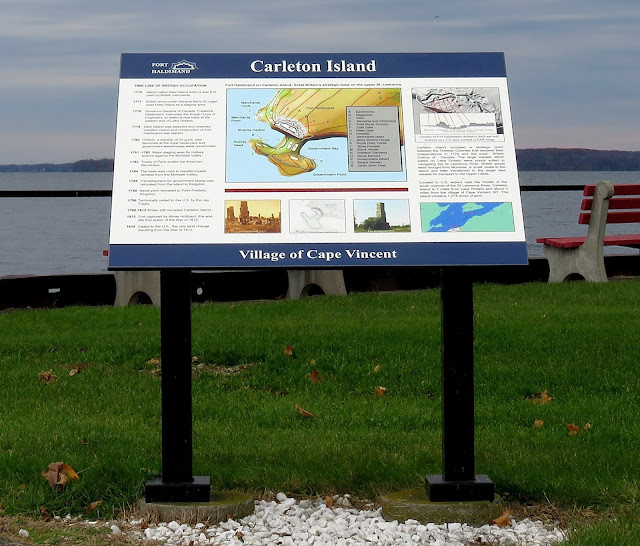
SRHF donates design and artwork for replacement Carleton Island informational panel is East End Park, Cape Vincent NY

During a visit to Cape Vincent's East End Park this summer, Dennis & Kathi McCarthy observed that the Seaway Trail informational panel for Carleton Island was deteriorated and not readable. They advised Cape Vincent Village Mayor Jerry Golden about the condition of the panel. Aware that a replacement is no longer available from Seaway Trails Inc.  Dennis & Kathi McCarthy, directors of St Lawrence River Historical Foundation, offered an updated replacement design for a new informational panel as a replacement.  Mayor Golden presented the proposal at the Cape Village meeting in July.  The village board approved the new panel purchase using the artwork. 


The new Carleton Island information panel has been mounted and can be seen in East End Park.


Friday, June 04, 2021

3D digital image of a George II  12 pound Iron Gun recovered from North Bay Carleton Island in 1973.  The gun is on display at Sacketts Harbor Battle Field in Sacketts Harbor NY. 


Saturday, February 17, 2018


Modern technology opens window into the Thousand Islands 


Fort Haldimand LIDAR Image
2017 LIDAR Image of Fort Haldimand, section circled in white shows about 400 feet of undisturbed outer earthworks.


Thursday, May 26, 2016


On May 24 and May 25 WWNY TV 7 aired a two part series by reporter John
Moore called "Secrets of Carleton Island."  


The story was initiated by information found on www.forthaldimand.com
with information about the 1970s underwater excavation of a revolutionary war ship and computer models of Fort Haldimand.

Permission to film on Carleton Island was provided by Thousand Islands Land
Trust  [TILT]. Their web site is
http://tilandtrust.org

Artifacts were displayed and shown through the courtesy of the New York
State Museum


Friday, June 05, 2015

A Plan of Fort Haldimand, a composite sketch from historical sources

As part of the effort to develop a computer model of Fort Haldimand a reference sketch has been developed to identify major features with their historical references. Over the next few posts each item in the sketch will be reviewed. This will be the basis of the next model.


Monday, February 16, 2015

Lt. James Glenie, one of the key individuals in the construction of Fort Haldimand

The 1988 Syracuse Harold America story  “Retracing a soldiers past" tells of a visit by the great great great grandson of James Glenie to Carleton Island.

Lt. James Glenie was one of the key individuals in the construction of Fort Haldimand.

From: Dictionary of Canadian Biography
In the summer of 1778 Glenie accompanied Lieutenant William Twiss to Oswegatchie (Ogdensburg, N.Y.) and Cataraqui (Kingston, Ont.) in search of a suitable site for a supply depot which Haldimand hoped to establish at the eastern end of Lake Ontario. Once Twiss had decided upon Buck Island (N. Y.), which he proposed to rename Carleton Island, he sent Glenie to report to Haldimand, expressing his confidence in him. Haldimand agreed with Twiss’s proposal for a post on Carleton Island, but as soon as the proposed works were well launched Twiss was to leave for Montreal and Glenie would “oversee and carry on that Business in your absence.”
Read more at: http://www.biographi.ca/en/bio/glenie_james_5E.html


Thursday, December 25, 2014

View of the ruins of Fort Haldimand from late nineteenth century post card.

Newspaper clipping at the Thousand Island Museum in Clayton NY shows a view of the remains of Fort Haldimand seen from the glacis with man standing at on the covert-way. Near intact chimneys in background. Image taken in the late nineteenth century.


Tuesday, June 17, 2014

St. Lawrence River Historical Foundation Inc. (http://home.netcom.com/~srhf/) has started a project to build a computer model of Fort Haldimand and the British Military base on Carleton Island in the St Lawrence River in Jefferson County, New York as it was in early 1780’s. St. Lawrence River Historical Foundation Inc is also referred to as SRHF

The remains of Fort Haldimand as viewed today are impressive but only a small portion of what once was one of the most important posts on the Great Lakes during the Revolutionary War. Ravaged by the elements, overgrowth of vegetation, relic hunting, land clearing and natural aging, what remains provided clues to what the base once was.

Using historical documents, first hand accounts and maps, SRHF will compile a physical description of the fort when it was at its prime. Satellite and aerial photograph will be combined with surveys from the 1800's to present refine details. The resulting information will become the basis of the computer model.

The advantage of the computer model is that will not be encumbered by properly access and can be updated easily as new information becomes known. The long term goal will be to make the computer model available either on the internet or at an information center in the Thousand Islands area.

The model building process will involve virtual low detail simulation-based models that will be the basis of an eventual photo realistic rendering solution. The following are some computer simulations used in a project feasibility study.


For more information email info@forthaldimand.com

Thursday, February 06, 2014

“Eighteen of Fort Haldimand's Men” by Stephen Davidson.

In the September and October issues of United Empire Loyalists of Canada news letter Loyalist Trails is an article “Eighteen of Fort Haldimand's Men” by Stephen Davidson.

“Carleton Island was the Gibralter of Lake Ontario; its Fort Haldimand linked the frontier with the settlements of the St. Lawrence River and guarded those settlements against possible invasion. Eighteen loyalists recounted their connection to the island during their testimony at the Royal Commission on the Losses and Services of American Loyalists (RCLSAL).” Stephen Davidson

To read the very well written, interesting and informational article you can click on the following links.
Eighteen of Fort Haldimand's Men: Part One, by Stephen Davidson
Eighteen of Fort Haldimand's Men: Part Two, by Stephen Davidson

Stephen Davidson has written for Canada's History Magazine, The Loyalist Gazette, The Dictionary of Canadian Biography and the online newsletter, Loyalist Trails. His book, "The Burdens of Loyalty: Refugee Tales from the First American Civil War”, is available through  <reachriver@gmail.com>.


Fort Haldimand 2013
Fort Haldimand 1973


Sunday, February 02, 2014

"So long have these old sentinels watched over the scenes that their history is lost in the misty past."

A nineteenth century description of Carleton Island from a guide for tourists and travelers.  

18 Years on the St Lawrence.
THE PEOPLE MET AND THINGS SEEN.

 E. F. BABBAGE, Publisher.
ROCHESTER, N. Y.
DEMOCRAT AND CHRONICLE PRINT, 47 & 49 EAST MAIN STREET. 1891

Page 77 - 79

 CARLTON ISLAND.

At the upper extremity the land narrows into a rugged promontory, ending in a bluff sixty feet in height. Here, lifting their ruined heads aloft, and plainly visible to all passers along the river, stand a number of toppling and half ruined chimneys. These may be seen for miles around. So long have these old sentinels watched over the scenes that their history is lost in the misty past. Around them are the remaining ruins of an old fort, supposed by many to be the ruins of old Fort Frontenac. Its old redoubts and parapets linger antiquated historical legends and traditions enough to fill a volume, which has been lately published by the editor of the St. Lawrence News, of Clayton, N. Y., forming an interesting study. A copy was presented to me by the publisher, but has been mislaid and cannot be found. An ancient well, cut in the solid Trenton limestone down to the level of the lake, has been converted by the reckless imaginations of the natives into a receptacle of the golden doubloons which the French soldiers, upon evacuating the old fort, are said to have thrown there, with the brass guns on top of them. Upon either side and immediately in front of the bluff upon which the old fort stands, is a quiet, pretty little bay, which may once have supplied a safe and easy anchorage for the vessels that lay under its protecting guns. The fortress is supposed to have been one of importance as a military post at some time, having been built upon an excellent plan and in the most substantial manner. Numbers of graves still occupy a field near by, the remains of the brave soldiers who once occupied the fort. The scene is of deep interest to the student of history. This island has been purchased by the Folger Brothers, and laid out in villa lots A grand barbecue and sale was held here in 1889 and many lots 79 were purchased by wealthy parties who intend to build upon the Island the coming season, and I have no doubt this will be one of the most popular resorts of the Thousand Islands. It is also used for picnics and pleasure parties. About six miles this side of Clayton is Lindsay Island, the only one on the right between Cape Vincent and Clayton, except Carlton Island just spoken of.

Friday, September 06, 2013

Map of Fort Haldimand

Map of Fort Haldimand


Unsigned and not dated this map is in a collection of documents at the Cape Vincent Historical Museum, Cape Vincent  NY.